



Taifa Local
the default path
- Data stored in Kenya
- Controlled hosting environment
- Billing terms open to negotiation
- Can be self-hosted
- Every call in one usage ledger
- Works with existing OpenAI clients
An OpenAI-compatible inference API with data residency in Kenya.
Trusted by:
Why local
A gateway in front of the models the fleet already runs, with one allow-listed way out to a third-party provider.
Every plain model tag runs through Ollama on hardware this project controls. It is the path a request takes unless someone asks for otherwise.
One model id is allow-listed to reach a third-party provider. A request only leaves the country when a caller names that id.
One endpoint speaking the OpenAI shape, streaming included. Existing client libraries work by changing a single base URL.
Served, refused or failed, each request writes a usage row the moment it happens, with a status and a token count you can bill against.
Requests and responses keep the shapes an OpenAI client already sends and parses, so moving an existing integration is a base URL change rather than a rewrite.
model:
"ministral-3:3b"

messages: [
  { role: "user",
    content: "Check the status of application 4471." }
]
streaming
Application 4471 is currently under review. It was received on 14 August and cleared document checks on 21 August. No decision has been recorded against it yet, so there is nothing further for the applicant to submit at this stage
Served today:
Compare
The two Taifa columns differ by one allow-listed model id. Both write to the same usage table.
Taifa Local
the default path
Taifa Cloud
gated fallback, allow-listed
Provider API
straight to a vendor
Sign in to the console and create a project key. The plaintext is shown once, then only its hash is kept.
Change the base URL on the OpenAI library you already use. The request and response shapes do not move.
Every call appears in usage with its status and token count, including the ones that were refused or failed.
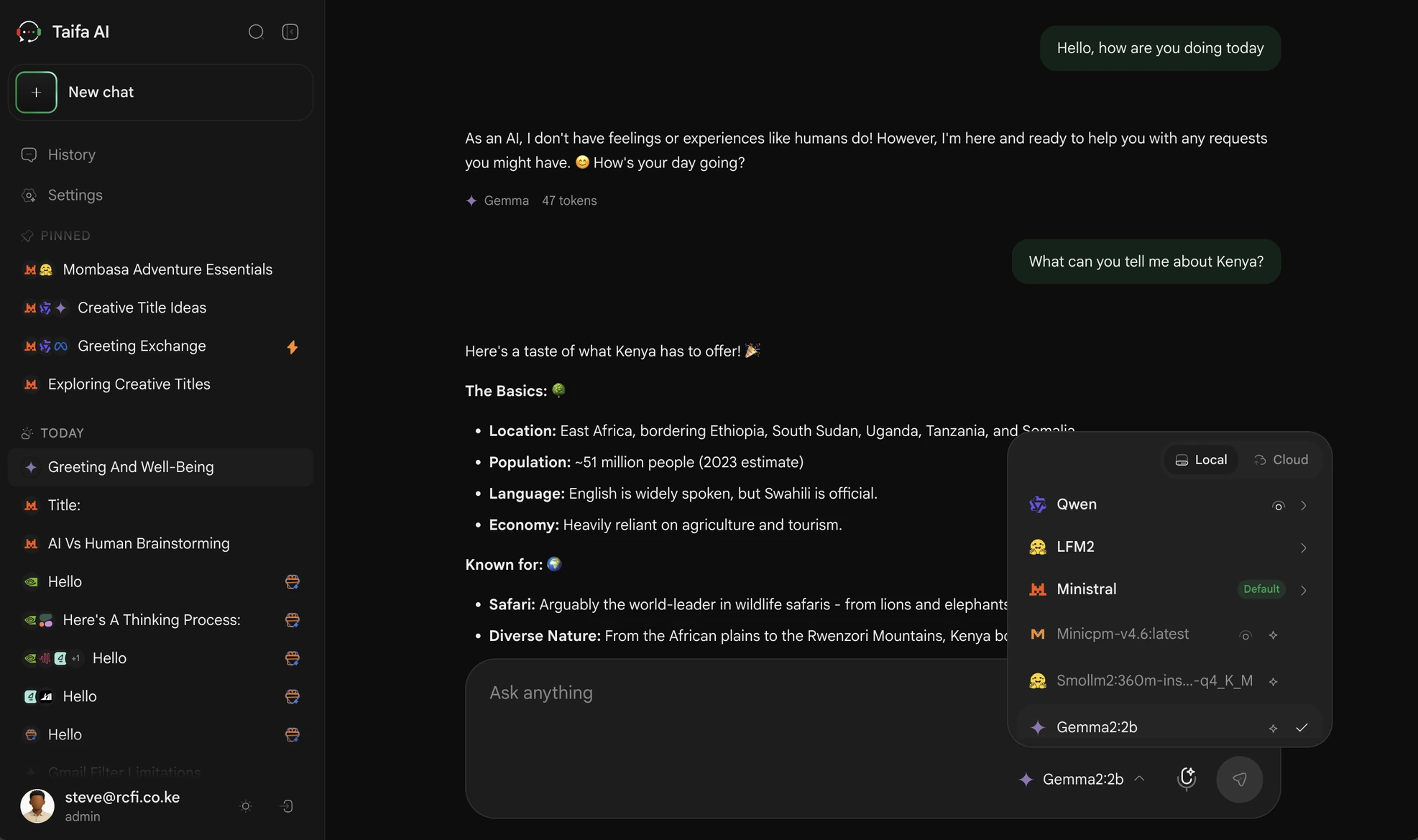
In the console
Each reply records the model that produced it and the tokens it cost. The picker switches between the local models and the gated cloud one.
Mint a key, change one base URL, then check usage. The quickstart covers all three.
Get started